
Marvell Technology Inc. stocks have been trading up by 6.74 percent after upbeat AI-chip growth guidance drove strong investor optimism.
Key Takeaways For MRVL Traders
- Marvell Technology raised its 2026–2027 revenue outlook to a combined $30B, up from $20B, and MRVL jumped roughly 7% on the announcement.
- At Analyst/Investor Day, MRVL laid out FY31 revenue targets of $70B–$90B and $30+ EPS, anchored in AI data center and interconnect demand.
- Multiple firms, including Jefferies, Piper Sandler, BofA, Needham, UBS, Evercore ISI, Craig‑Hallum and Oppenheimer, lifted MRVL price targets into the $350–$450 range.
- New Alaska high‑speed connectivity chips for next‑gen AI data centers are now sampling, reinforcing Marvell’s execution on its AI networking roadmap.
- MRVL is showcasing a broad AI data center portfolio and partnering with Microsoft and Oracle in an OCP hardware security effort for hyperscale clouds.
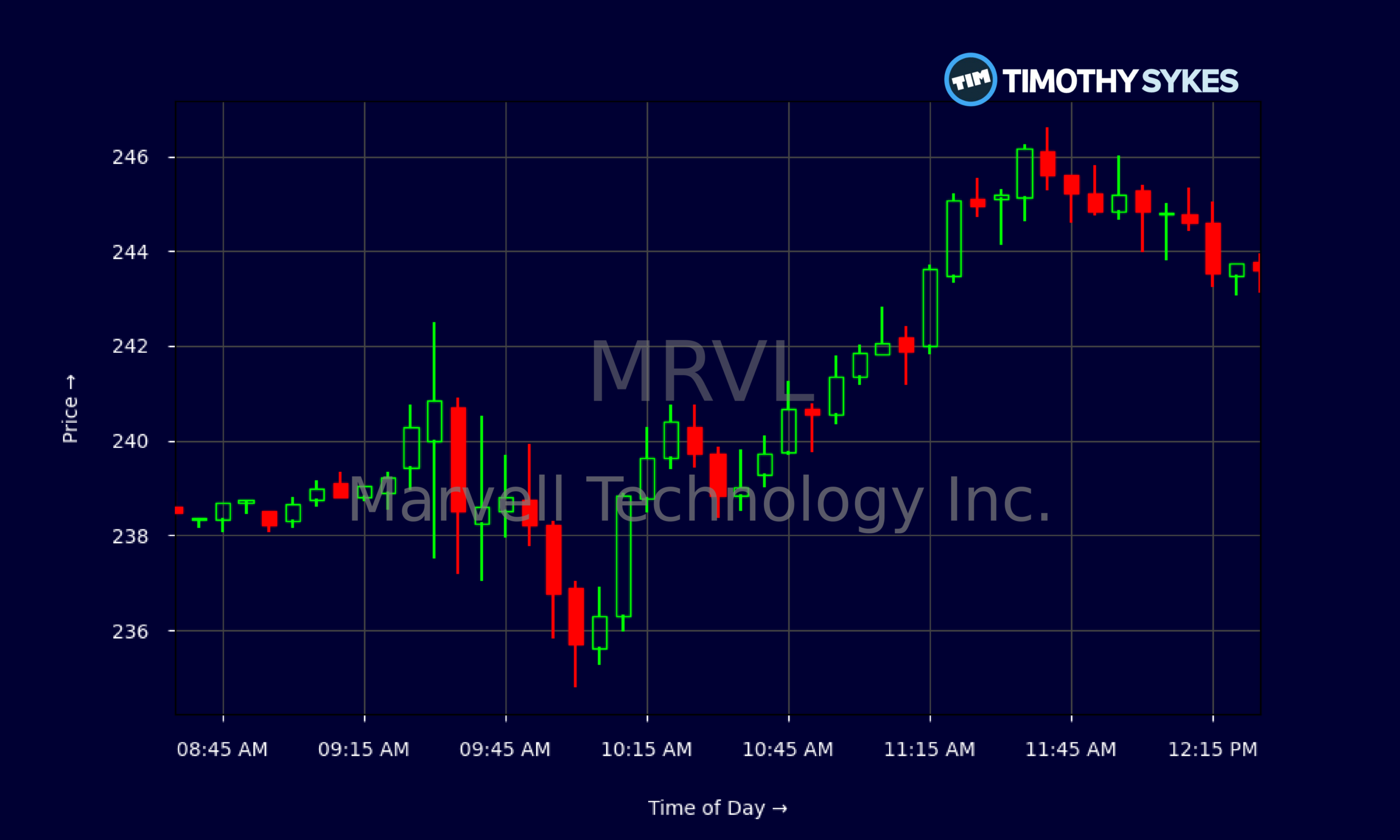
Live Update At 12:32:36 EDT: On Monday, October 19, 2026 Marvell Technology Inc. stock [NASDAQ: MRVL] is trending up by 6.74%! Discover the key drivers behind this movement as well as our expert analysis in the detailed breakdown below.
Quick Financial Overview
MRVL has been trading like a high‑beta AI leader. Over the last few weeks, the stock has swung between the low $250s and just above $300, then pulled back toward the mid‑$240s. The recent close near $243.19 shows a cool‑down phase after a sharp pop, which often sets up key support and resistance tests for momentum traders.
Intraday, MRVL’s 5‑minute tape shows a steady grind higher from the mid‑$230s into the mid‑$240s, with tight ranges and controlled dips being bought. That’s classic strong‑trend behavior rather than liquidation.
Fundamentally, Marvell Technology is not cheap. A P/E above 90 and price‑to‑sales above 25 signal that traders are paying up for growth. Profitability is solid for a growth name: gross margin sits above 50%, with EBITDA margin north of 45% and operating margin in the low‑30s. The balance sheet is clean, with a current ratio around 3.2 and modest leverage.
More Breaking News
MRVL generated about $2.74B in quarterly revenue and $308M in net income in the latest report, translating to roughly $0.33 diluted EPS. Free cash flow of about $474M shows the business is throwing off real cash, which matters when a stock is priced for perfection.
Why Traders Are Watching MRVL Right Now
MRVL has turned its latest Analyst/Investor Day into a full‑blown AI growth story. Marvell Technology didn’t just tweak guidance; it rewired the curve. Management raised its 2026 revenue outlook to $12B and 2027 to $18B, lifting the combined 2026–2027 target from $20B to $30B. The market responded fast—MRVL ripped 5–7% higher on the news, printing around $289 at one point as traders chased the upgraded trajectory.
That near‑term ramp sits on top of an even bigger long‑term picture. MRVL is now talking about roughly $80B in revenue and around $30 EPS by 2030, and an FY31 framework of $70B–$90B with $30+ EPS power. For context, the company did about $8.2B in revenue last year. That’s an order‑of‑magnitude growth plan centered on AI data center infrastructure—interconnect, optics, custom compute silicon, and memory expansion.
The Street has piled on. Jefferies pushed its MRVL target to $450, Piper Sandler to $400, BofA and Needham to $400, Evercore ISI to $433, UBS to $350, Craig‑Hallum to $380, and Oppenheimer and RBC to $425. These aren’t small bumps; they’re wholesale rewrites of what MRVL can earn mid‑decade.
Underneath the guidance, Marvell Technology is showing product proof. New Alaska connectivity parts—a 3.2T 224G‑lane retimer and a 1.6T AEC DSP on 3nm—are already sampling for AI scale‑up networks. Its second‑generation Structera X CXL 3.2 memory controllers aim at hyperscale AI inference, backed by ecosystem work with AMD, Arm, Alibaba, Samsung, and SK hynix. Add in MRVL’s role at the 2026 OCP Global Summit and its new security working group with Microsoft and Oracle, and traders get a picture of a company embedded deep in the AI data center stack.
Conclusion
For active traders, MRVL is a textbook high‑expectation momentum name. The stock already carries a premium valuation, yet management just cranked up revenue goals from $20B to $30B in 2026–2027 and is talking $70B–$90B by FY31 with $30+ EPS potential. That kind of guidance, tied to concrete AI data center products and hyperscaler relationships, explains why Marvell Technology keeps attracting aggressive price targets in the $350–$450 band.
But rich stories cut both ways. When a stock like MRVL is priced off future AI cash flows, the chart becomes a real‑time vote on whether traders still believe. If Marvell Technology delivers on design wins in interconnect, custom compute, optics, and CXL memory, the growth path the Street is modeling stays intact. Any stumble in execution, or a slowdown in AI capex, and high multiples can compress fast.
This is where discipline matters. As Tim Sykes likes to remind traders, “The market doesn’t care about your opinion, only your risk management. Cut losses quickly, and let the best setups prove themselves.” As millionaire penny stock trader and teacher Tim Sykes, says, “There is always another play around the corner; don’t chase just because you feel FOMO.”. For MRVL, that means respecting key technical levels, tracking each guidance update against reality, and treating the AI narrative as a trading edge only as long as the numbers and the tape stay aligned. This article is for educational and research purposes only and is not investment advice.
This is stock news, not investment advice. Timothy Sykes News delivers real-time stock market news focused on key catalysts driving short-term price movements. Our content is tailored for active traders and investors seeking to capitalize on rapid price fluctuations, particularly in volatile sectors like penny stocks. Readers come to us for detailed coverage on earnings reports, mergers, FDA approvals, new contracts, and unusual trading volumes that can trigger significant short-term price action. Some users utilize our news to explain sudden stock movements, while others rely on it for diligent research into potential investment opportunities.
Dive deeper into the world of trading with Timothy Sykes, renowned for his expertise in penny stocks. Explore his top picks and discover the strategies that have propelled him to success with these articles:
- Penny Stocks Trading Guide
- Best Penny Stocks Under $1 to Buy Today
- Top 8 Penny Stocks to Watch on Robinhood
Once you’ve got some stocks on watch, elevate your trading game with StocksToTrade the ultimate platform for traders. With specialized tools for swing and day trading, StocksToTrade will guide you through the market’s twists and turns.
Dig into StocksToTrade’s watchlists here:




Leave a reply